Over the last couple of months, I found my vibe-coding workflow to be as follows:
- Start some work on a new feature branch
- Ask Claude to implement the feature
- Ask Codex to review the feature
- Pass Codex’s feedback back to Claude
- Go through steps 2,3,4 in a loop a few times until Codex and I are both satisfied
- Commit and ship
When Claude is so capable, why did I waste time and tokens on reviews from Codex? Because no matter how smart a worker is, an audit by an equally smart reviewer is likely to uncover areas of improvement. The reviews almost always found important things that needed to be addressed. Could I have found these problems myself? Maybe some of them, but definitely not all.
Soon I got tired of copy and pasting the feedback back and forth in two different harnesses. So I began asking the reviewer to write its feedback in a markdown file. I would then point the implementer to the .md file. But I didn’t want to keep switching back and forth between Codex and Claude. Laziness is the mother of invention. Hence mash.
Mash (Multi Agent Super Harness) is a GUI and CLI meta-harness that enables pair programming for AI agents. Instead of working individually with Claude or GPT or Neon, you work with a pair of agents. One implementer, one reviewer.
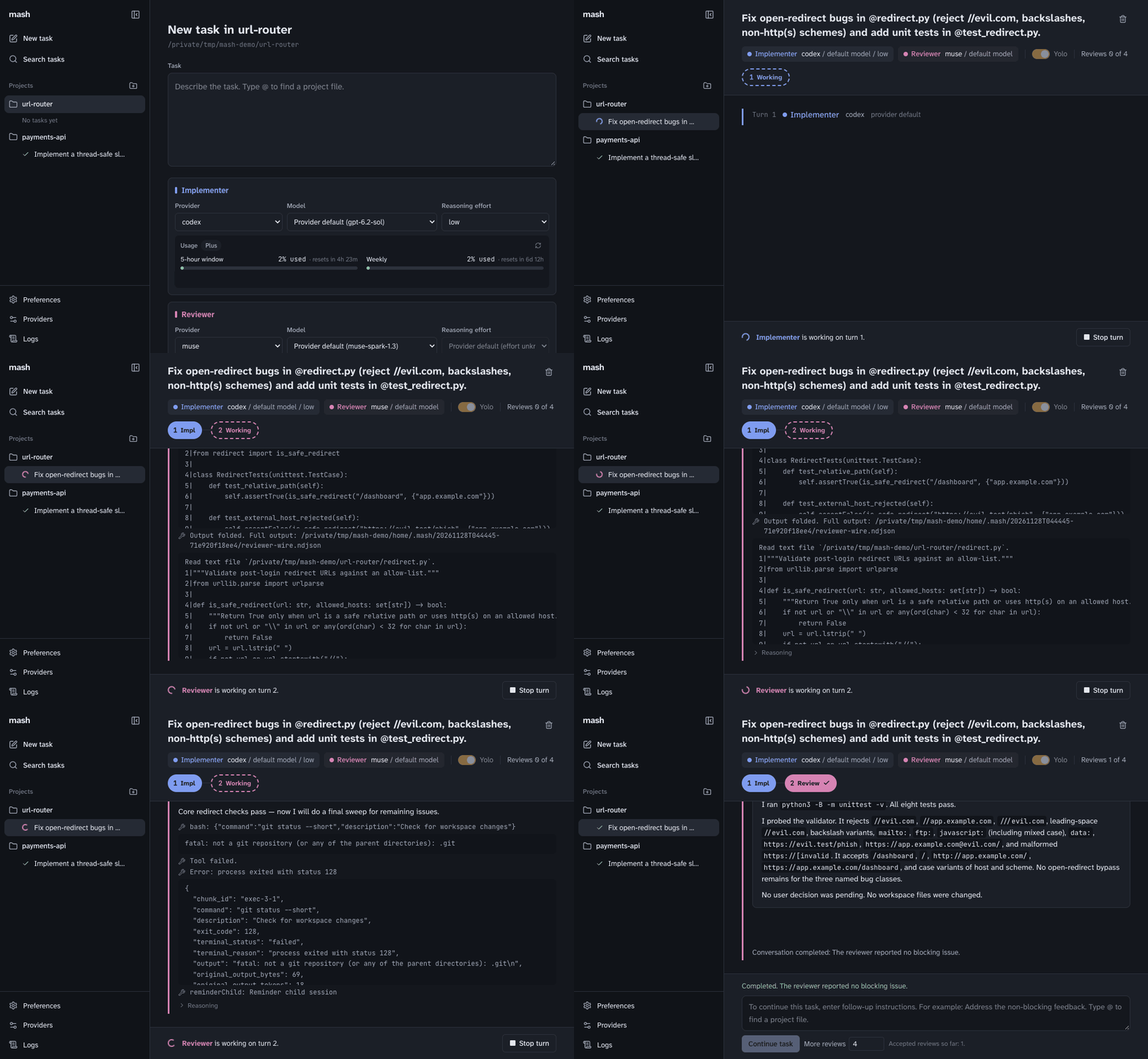
Mash uses the first-party CLIs from all major American providers (Claude Code, Codex, Antigravity, Grok, Muse) so you can use your existing subscriptions. The frontier is competitive. A different model is in the lead every few weeks. So I have subscriptions for every LLM out there: Claude, Codex, Gemini, Grok, Muse. Aside: As of Thanksgiving 2026, Opus 5.5 is my go-to model but Gemini Neon 4 is starting to give Opus a run for its money.
Quick start
brew tap diffen/mash
brew trust --cask diffen/mash/mash-harness
brew install --cask diffen/mash/mash-harness
mash --version
open -a mash
MacOS might complain about running software downloaded from the Internet. You will have to trust me and “Open Anyway”. Or have your agent clone the repo and build from source.
How Mash Works
The worker ↔ reviewer loop is based on a communication protocol that is explained to both agents. Each agent writes a markdown file at the end of their turn, and agents can read each other’s files. That’s how they communicate. If either agent has a question, mash propagates that question to the user. The questions and answers are shared with both agents so they each have the full context of what the user wants. This is also the mechanism for dispute resolution.
Recursive Self Improvement (RSI)
Ever since I was a teenager first learning programming, I’ve found recursion to be charming. I remember using it to brute force all 92 solutions to the eight queens puzzle. Recursive self-improvement is when AI models train better versions of themselves. You can imagine how powerful this is, and how it can drive exponential increases in capabilities really quickly.
It is one thing to imagine it but it is quite another to actually use it. Once I had the basic mash meta harness set up, I used mash to improve mash. This was a joyful experience, even if it was with a human in the loop.